
Pinship: A New Dimension for Evolutionary Art
Student: Sam Price
Professors: Andrea Macruz + Manali Truitt * MFA Director: Christine Facella
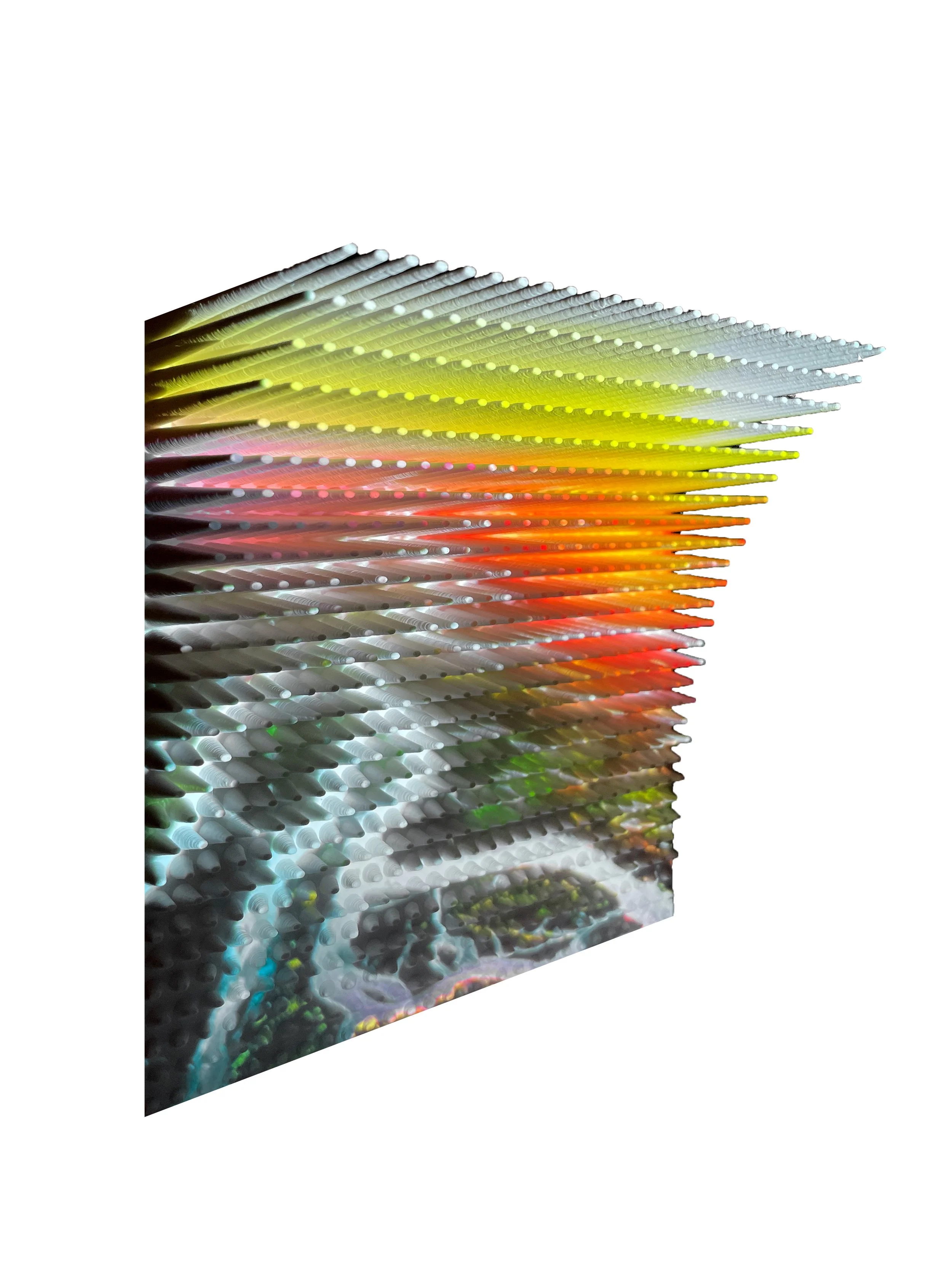
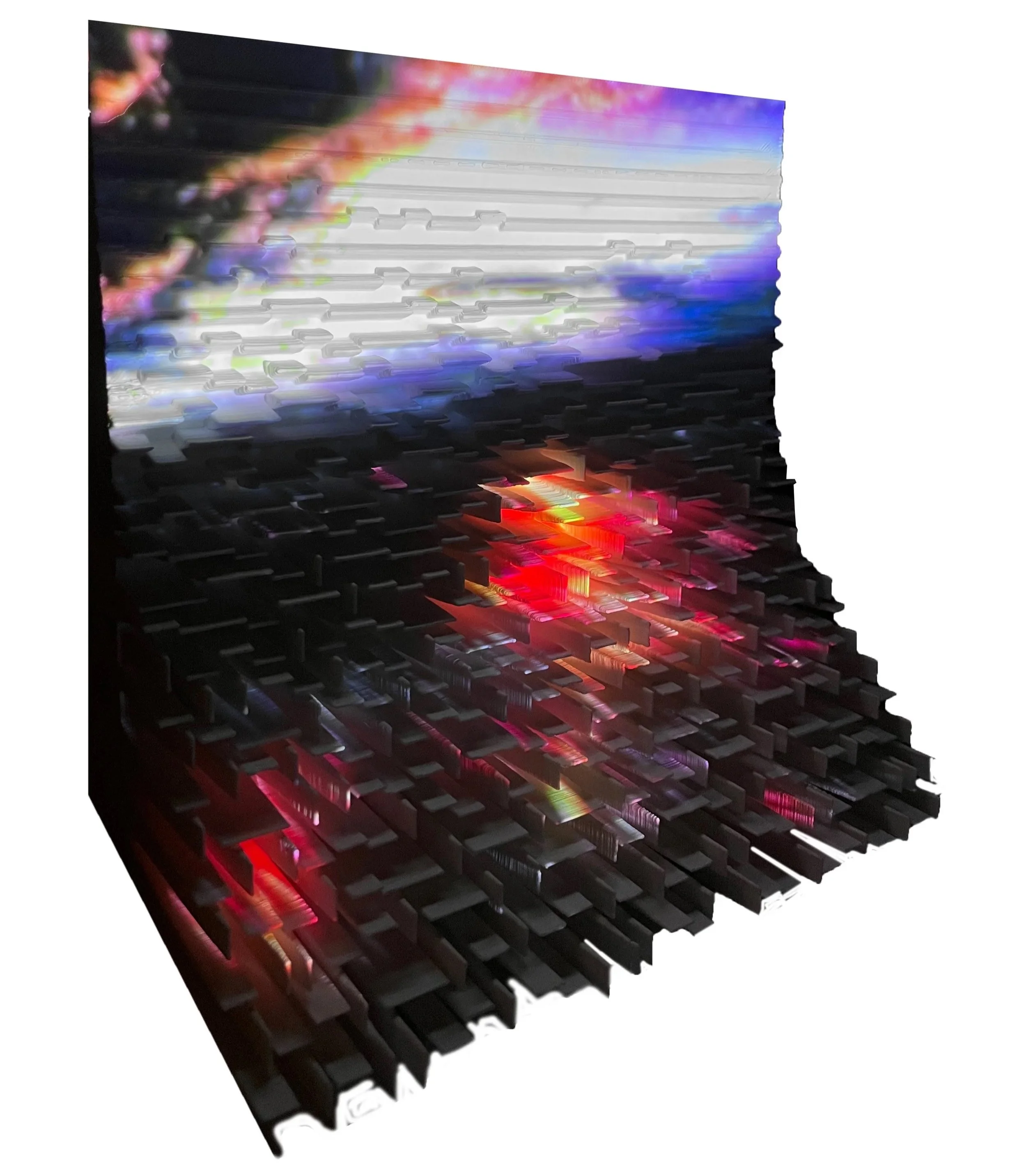
Special thanks to Professors Hossein Adeli and Mark Bechtel
The iterative process began with a structured design probe investigating how Rodrigo Quiroga's (2021) concept cells, foregrounded within predictive processing, operate when perception involves multiple sensory dimensions simultaneously. Designed by students Sam Price and Kerry Xu, the probe presented five participants with 24 combinations of three landscape images and four 3D-printed textures projected together on a single surface, each shown for 90 seconds and rotated 180 degrees at the midpoint. Participants were asked what each combination evoked and which orientation they preferred. Findings revealed that the texture consistently transformed the meaning of the image: the same landscape paired with different textures triggered entirely different associations, from open space to layered material to fabric-like pattern, demonstrating that concept cells respond to the full sensory field rather than to the image alone. Participants also expressed a strong desire for physical interactivity and tactile engagement, and suggested larger scale and movement as directions, indicating that the fixed display format was insufficient for the kind of associative exploration they wanted to perform. These findings directly informed the shift toward a communal installation combining digital image evolution with physical tactile accumulation.
Image on the top: sources - “Hierarchy of visual processing in ventral and dorsal streams” | “Neuroscientific insights about computer vision models: a concise review”
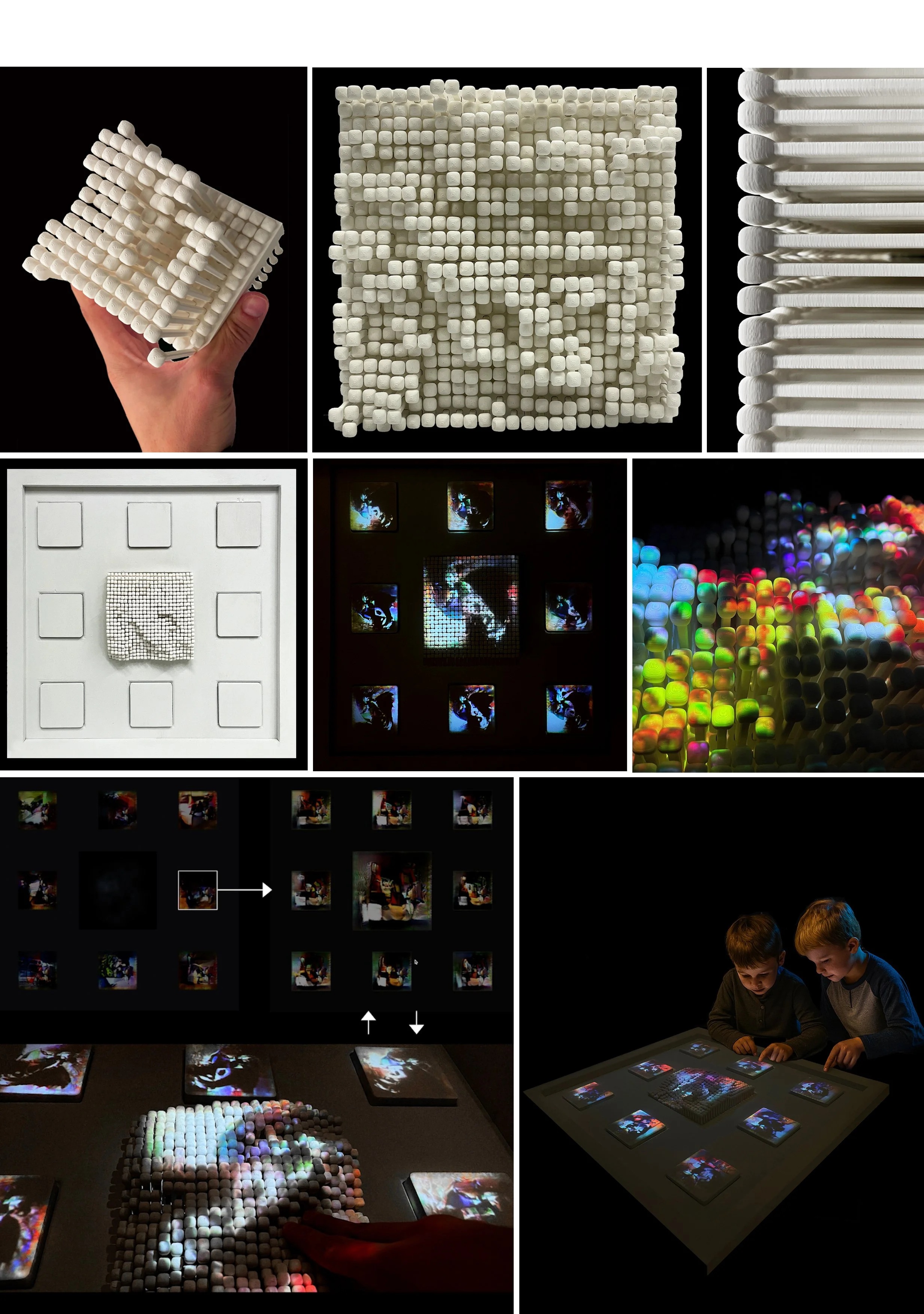
Images for projection onto different textures, 3D-printed texture prototypes without projection, the design probe testing session, and image-texture combinations.

Drawing on Quiroga's concept cells, foregrounded within predictive processing, the student Sam Price developed Pinship, a communal installation that extends the tradition of evolutionary art by introducing a physical and tactile layer that digital evolutionary art has historically lacked. Where existing platforms such as Picbreeder allow users to select and evolve images through purely digital interaction, Pinship proposes that meaning is not only seen but felt and accumulated over time through physical engagement.
The installation consists of a table-mounted display housing eight surfaces, each receiving a projected image generated through an evolutionary algorithm, arranged around a central physical pinboard, fabricated from FSC Baltic Birch plywood using CNC routing, with 3D printed PLA components. Users select an image, which becomes the parent for a new generation of algorithmic variations projected across the surrounding surfaces. Simultaneously, the physical pinboard at the center accumulates tactile modifications as users press, rearrange, and add to it over successive sessions, with each person's contribution changing what the next person perceives and how they respond, creating a chain of associative reconstructions in which each modification becomes the stimulus for the next. The interaction loop follows a four-step cycle of perception, selection, physical evolution, and repetition. The full installation proposes a table-mounted display in which image selections are made through tactile push latch mechanisms, with an Arduino Leonardo controlling the display logic and a Mac Mini processing the generative image evolution. During testing, 10 participants described an installation in which meaning accumulates, shifts and reinterprets itself through repeated engagement, suggesting that concept cells can function as a structural principle rather than a theme.
Image on the top: close-ups of the 3D-printed pinboard, the complete art installation viewed from above without projection, the installation with projection featuring a central image surrounded by slightly mutated variations, and a close-up of an image-texture combination.
Image on the bottom: the final art installation and an image showing audiences gathered around the tabletop. The main visual is recursively transformed by each visitor's image selection, activated through push latches in the final installation, while its physical manifestation is altered as visitors reposition the pinboard onto which it is projected.
A projected image generated through an evolutionary algorithm
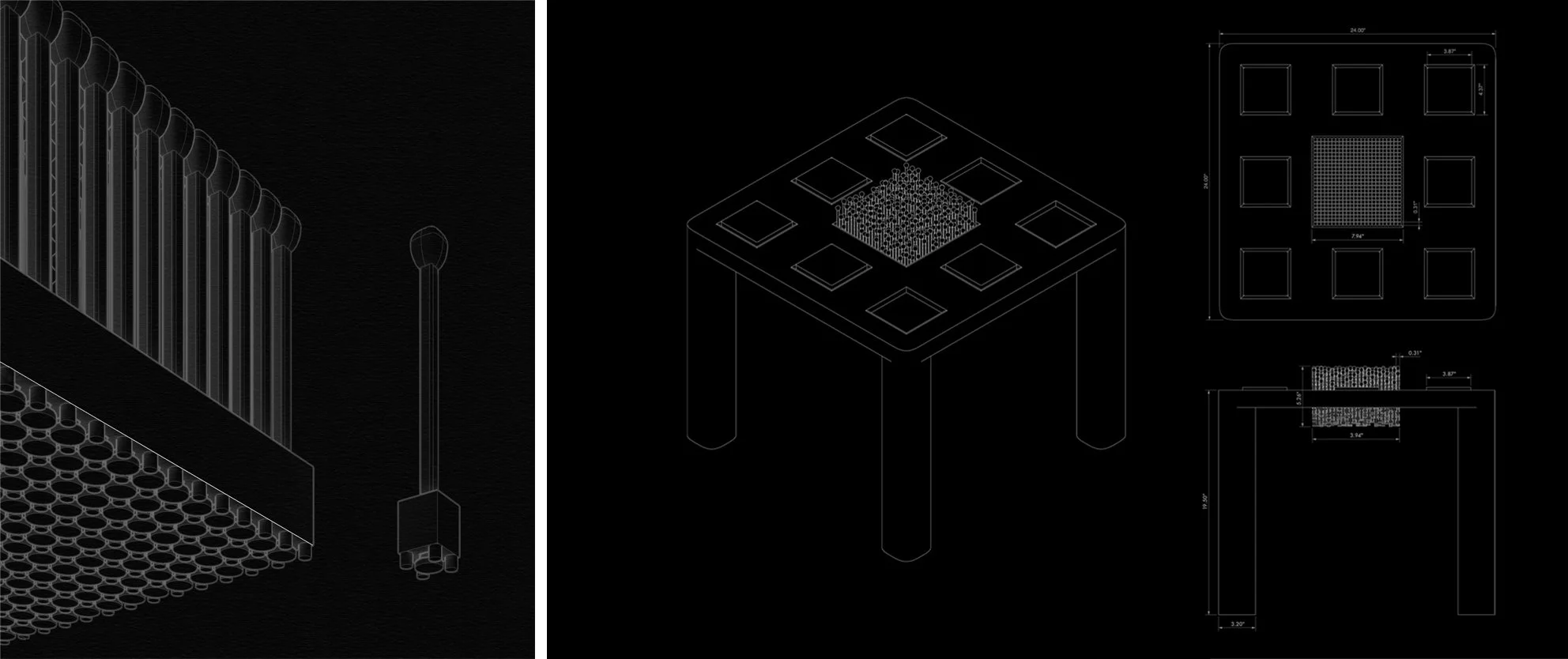
A close-up of the 3D-printed pinboard and the complete art installation